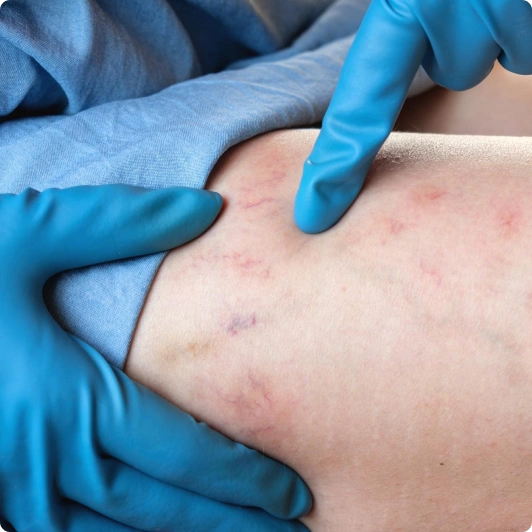
Removal of capillaries and visible blood vessels
More about the procedure
Description
Gentle and effective treatment of superficial vascular lesions (fragile capillaries, "burst" veins and redness).
LUÑA Ray uses Intense Pulsed Light (IPL) with a 530nm or 590nm filter to treat superficial vascular lesions. The light is absorbed by the hemoglobin in the blood vessels, which leads to their selective heating and gradual destruction. The skin remains intact, and the results are cumulative with each subsequent treatment.
What vascular changes can be treated?
- Fragile capillaries on the face
- Redness on the nose and cheeks (rosacea)
- Telangiectasias ("burst capillaries")
- Mild erythema and diffuse redness
- Spider veins (superficial)
How does the procedure work?

The skin is cleansed and the areas around the eyes and lips are covered with a white marker.
A gel is applied for better light transmission.
The IPL applicator is held about 5 mm from the skin and 1 shot is applied per point.
It starts at the farthest end of the vascular network and moves towards the center.
The procedure lasts 10–20 minutes depending on the area.
How many procedures are needed?
Recommended course: 4–6 procedures, with an interval of 4 weeks between them.
Redness often decreases after the first procedure, but the best effect is achieved after a full course.
Post-procedure care:
- Use of photoprotection (SPF 50+)
- Applying aloe vera or vitamin C/E cream
- Avoiding intense physical exertion, saunas and hot water in the first 48–72 hours.
- Do not use acids, retinoids or aggressive cosmetics for up to 5 days
Contraindications:
- Active skin infection or inflammation
- Tendency to keloids
- Pregnancy and breastfeeding
- Taking photosensitizing medications
- Recent exposure to the sun or tanning bed
Note for darker skin (Phototype V–VI):
For darker phototypes, IPL is not suitable for vascular lesions. It is recommended to use an Nd:YAG laser, which penetrates deeper and has a lower risk of pigmentation.
IPL therapy with LUÑA Ray offers an effective and gentle solution for capillaries and skin redness, without the need for a recovery period and without damaging the surface structure.